Clinic done. Charts signed.When your day is done, so are you.
You will never chart again at home. Scribient is a complete practice operating system. Intake, scribing, orders, sign-off and billing all run in one place, and every chart is finished and signed at the end of the encounter. Built for surgical practices: general, neurological and spine, plastic and urological.
Nothing said in the room gets left out of the chart.
Review time95% less
Scan, confirm the few flagged values, sign. You can trust the rest.
From Scribient's internal testing of transcript-to-note accuracy across two model providers.
Built for surgeons' days
Notes that get you paid, approved and home.
Your chart has to prove conservative care, capture the consent conversation, get the side right and survive a payer review. Scribient does all four in every note, automatically.
Prior auth starts in the note
Pain scores, ODI and NDI, and your PT orders are in the chart at every visit, and Scribient drafts the prior-auth letter from it. The proof is already there when the payer asks.
30% of spine surgery denials are for missing proof of physical therapy (AAOS 2026).
The consent talk, on the record
The risk–benefit conversation is recorded with the visit, and anything said but missing from the note is flagged before you sign.
In spine malpractice claims, failure to explain the risks is the most common consent allegation: 30.4% of them (JAMA Surgery 2017).
Right side, every time
The exam and the body map set the side. Diagnosis codes and imaging, PT and DME orders follow it, so the side on the codes matches the side on the orders.
Payers deny claim lines when the diagnosis side and the RT/LT modifier don't match (EmblemHealth policy).
Your template, your voice
Notes come out in your own template and your own words. Every note is finished at the end of the visit. Getting started is easy too: your setup specialist rebuilds the templates you use today.
The top complaint about scribes: notes that don't sound like the surgeon.
Workers' comp and injury cases
Date of loss, attorney, adjuster, claim numbers, treatment limits and case-type checks live in the chart, ready for the paperwork these cases demand.
Precertification for workers' comp takes 14.4 days, against 9 for commercial.
Nothing lost when the Wi-Fi drops
The visit keeps recording on the device when the connection goes, and it's sent the moment it's back.
Clinic Wi-Fi is the most common complaint about ambient scribes.
Need op notes, procedure notes or a connection to your current system? Tell us. The first ten ACOS practices help decide what we build next.
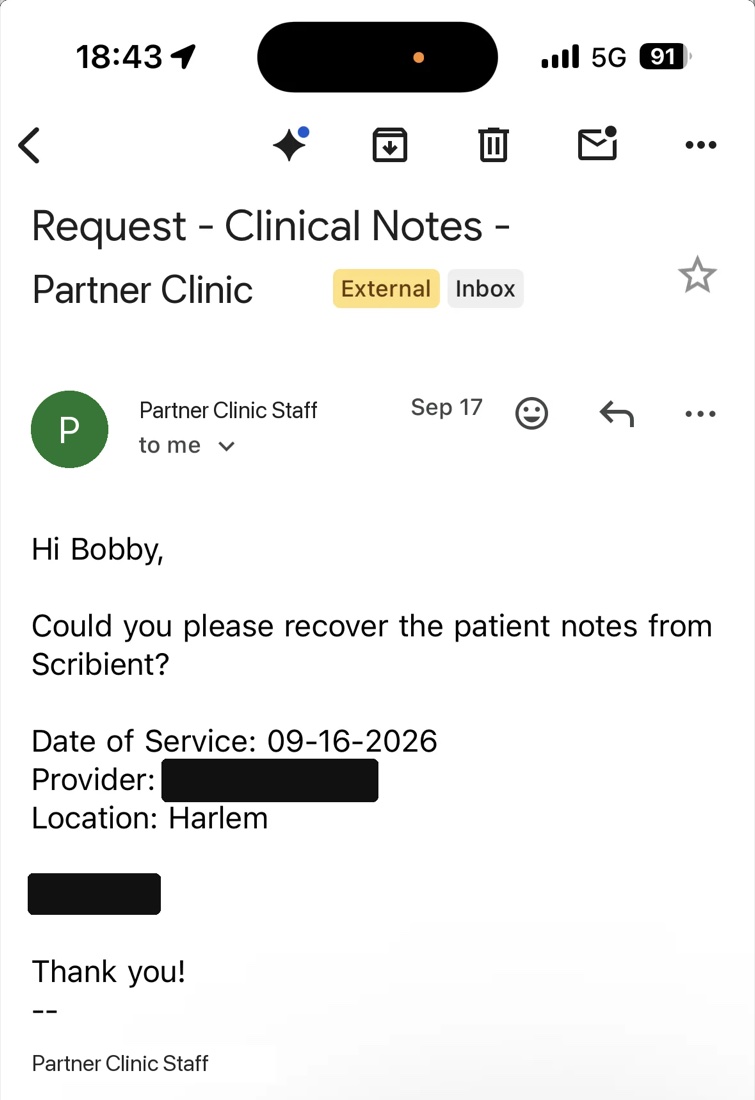
When their system came up short, they asked Scribient.
A real practice hit a problem with their system and needed a day of notes back. They emailed Scribient. Every visit was already captured, and the notes were recovered.
The practice's name is changed and the provider and patient names are blacked out, for privacy.
The ACOS offer
Founding pricing for the first practices.
Only for practices that sign here at ACOS. Nothing due on setup for 90 days, your hardware kit ready to go, and a per-patient rate you keep for good.
SetupNothing due for 90 days. 100% satisfaction guarantee: if you're not happy with Scribient, you don't pay it.
Due in 90 days$5,000
Hardware kitiPads, microphones, boom mics and connectors: everything your office runs Scribient on. Best paid here at the show.
One time$2,500
First 90 daysPay only for the patients you see.
Per patient visit$0.59
After 90 daysYour founding rate, and you keep it.
Per patient visit$1.99
What your practice pays
Hardware kit, one time$2,500
Months 1–3$236 / mo
Setup, due at day 90$5,000
From month 4$796 / mo
$0.59 per patient visit for 90 days, then $1.99, locked in. Not happy by day 90? You don't pay the setup fee.
Guaranteed migration
Your templates, set up for you.
A dedicated setup specialist rebuilds the templates you use today, whether they're on paper or in older charting software, so your notes look the way you already write them. It's a one-time setup, and scribing migration is guaranteed. After that, every note is finished at the end of the visit.
Included with every ACOS spot
Guaranteed scribing migration, with one specialist who owns your setup from start to finish.
Step 1Send what you use now
Paper forms, or exports and examples from your current software.
Step 2 · your specialistTemplates mirrored
Intake forms, note templates and orders rebuilt to match how you work.
Step 3Ready to see patients
Your first visit ends with a finished, signed chart.
Real problems, solved
See how Scribient solves the problems that cost you.
Denied surgeries, lost consent conversations, wrong-side codes, dropped connections. Watch Scribient fix each one.
Stop spine surgery denials before they happen
The proof of conservative care payers demand is already in every chart, and Scribient drafts the prior-auth letter from it.
Every risk you discuss, on the record
Scribient records the consent conversation and flags anything missing from the note before you sign.
Right side, right code, signed before you leave
Your exam sets the side, the codes and orders follow it, and the chart is signed before you walk out.
Wi-Fi drops. Nothing is lost.
Scribient keeps recording on the device and catches up the moment the connection is back.
See it in action
One visit, start to finish.
Watch a full visit run on Scribient: a hands-free start, tablet check-in, forms that fill themselves, a note that writes itself while you talk, and one signature. Done.
2:52 · the full walkthrough
How the day ends
Done before the patient leaves.
Chart notes and orders are finished at the end of each encounter: signed, complete and ready for billing, ICD-10 codes included. When the last patient goes, so can you.
01 · Intake and screening
The forms fill themselves
Patients answer on the tablet or at home, and your MA's screening conversation fills in the rest.
02 · The visit
The note writes as you talk
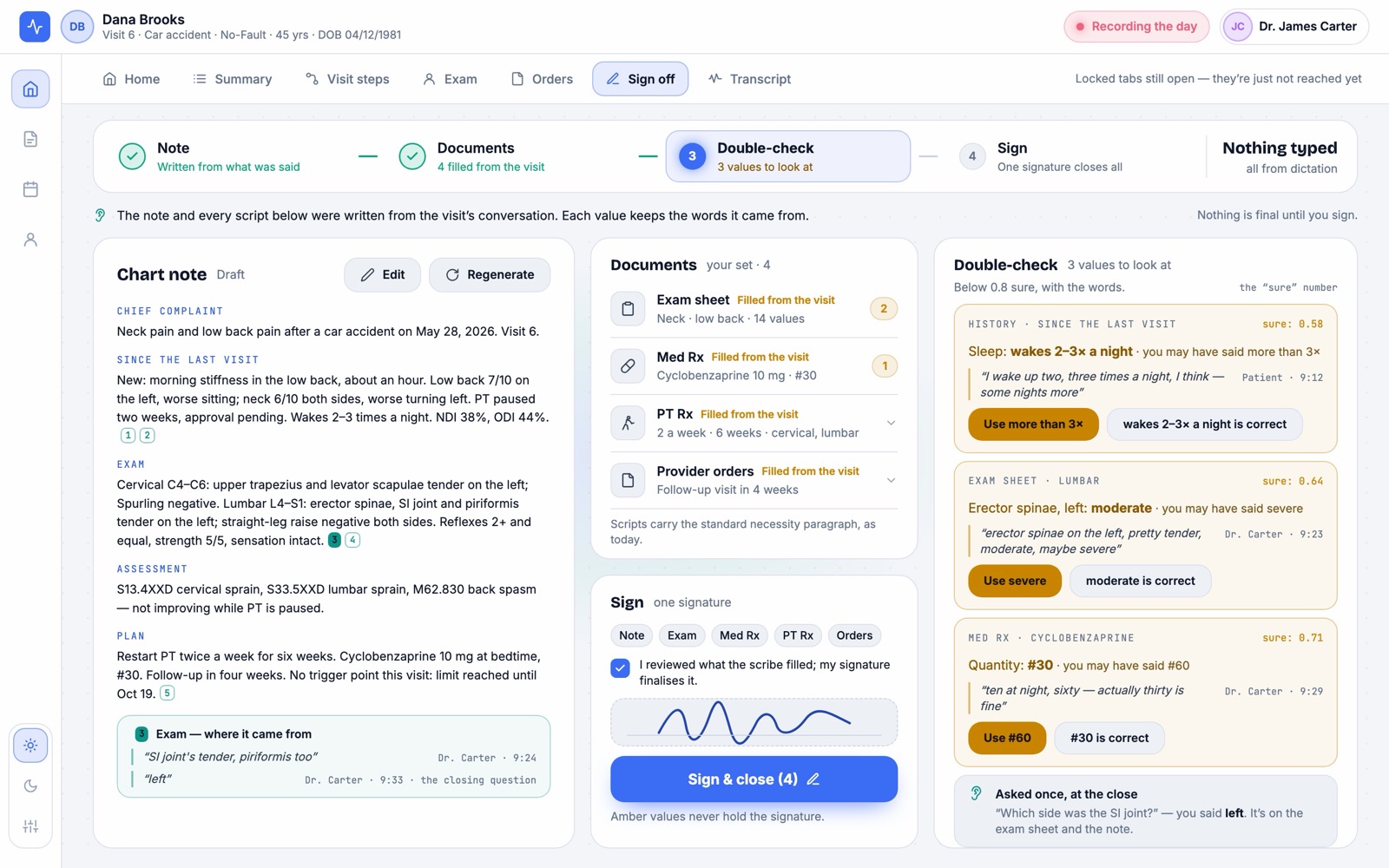
The scribe drafts the chart note, orders and documents from the conversation, each value with the words it came from.
03 · Sign once
Signed and ready for billing
Glance at the few flagged values, sign once, and the claim is ready with its ICD-10 codes.
Sign-off in Scribient: the note, the documents, three values to check, one signature.
Questions surgeons ask
Straight answers.
How was accuracy measured?
We ran the same visits through our transcript-to-note pipeline in multiple tests, using models from two different providers, and checked the finished notes and orders against what was said. Ask us at booth 105 and we'll walk you through the results.
Who signs off on the chart?
You do. Nothing is final until you sign. You scan the note, confirm the few values Scribient flags, and one signature closes the chart, its orders and its documents.
Do you sign a BAA?
Yes. We sign a Business Associate Agreement with every practice, every signature is tamper-evident, and every read and signature is kept in an audit trail.
What happens to my current templates and system?
A dedicated setup specialist rebuilds your paper or current software templates when you sign up, so your notes look the way you already write them from the first visit. After that, every note is finished at the end of the visit. Tell us what you use today and we'll plan the move with you.
Claim your spot
8 of 10 spots left.
Claim yours now and we'll book your setup.
$5,000 setup, nothing due for 90 days
100% satisfaction guarantee on setup
$0.59 per patient visit for 90 days, then $1.99, locked in